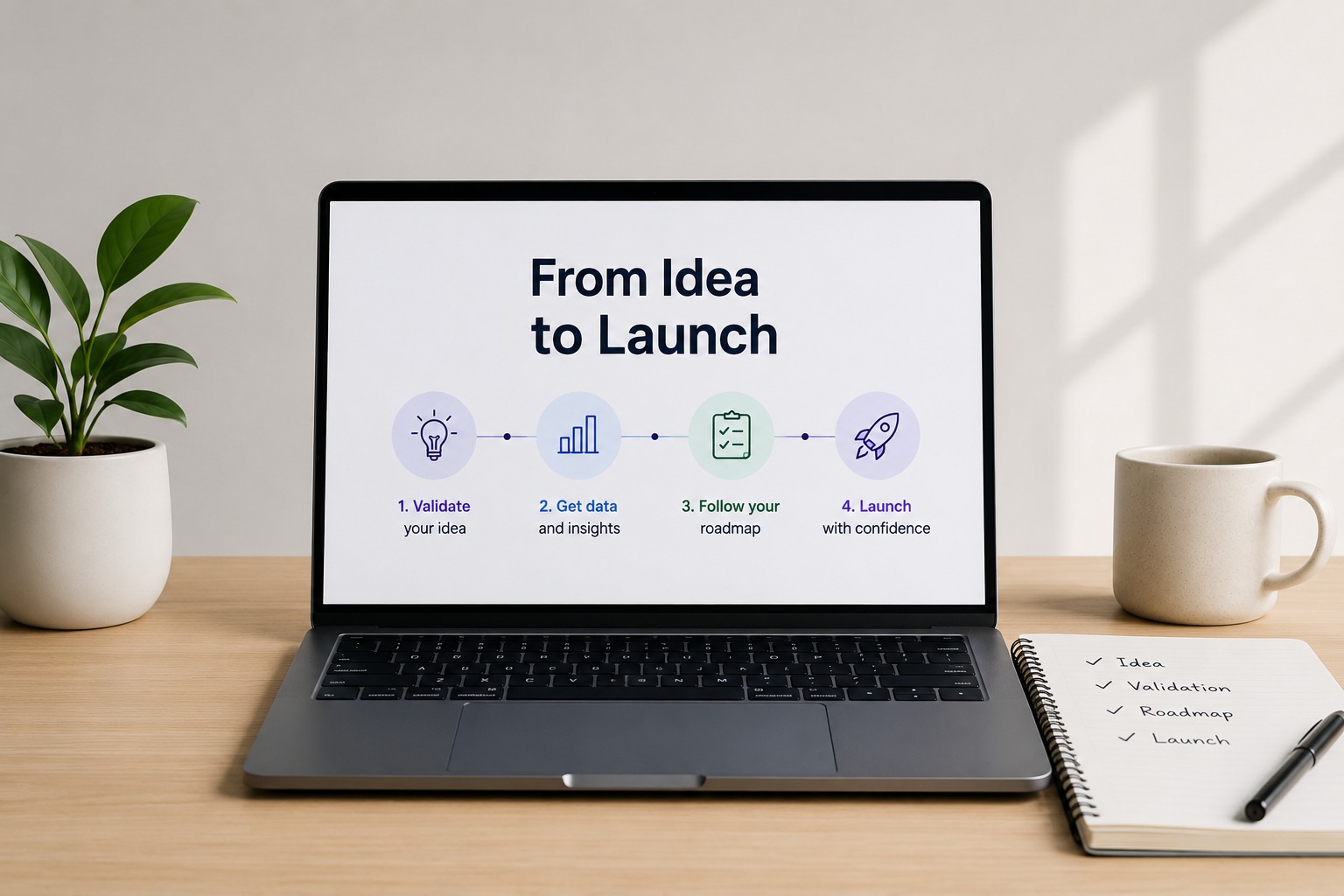
Most startup ideas do not fail because the founder lacked motivation. They fail because the team started building before they knew who their first customer was.
That is why idea validation software has moved beyond a simple “is this a good idea?” score. The most useful tools help founders find real people who already have the problem — before writing a single line of code. They also need a way to test demand, understand competitors, identify risks, and share a clear plan with co-founders, investors, and early customers.
That is where roadmap sharing and idea validation software comes in. Instead of leaving you with a scattered list of notes, it turns early market research into a practical roadmap: who to talk to first, what to validate before building, which assumptions are risky, and what evidence should change the plan.
Quick definition
Roadmap sharing and idea validation software helps founders test whether an idea is worth pursuing, then turns the findings into a clear, shareable plan for customer discovery, MVP development, and go-to-market execution.
What is roadmap sharing and idea validation software?
At a basic level, idea validation software helps founders answer one question: “Is this idea worth more research, testing, and investment?” A strong platform looks at signals such as market demand, customer pain, competitive gaps, business model potential, risks, and timing.
Roadmap sharing adds the next layer. It helps the founder communicate what should happen after the initial validation. A roadmap is not only a schedule. It is a strategic document that explains direction, priorities, and progress. For a startup, that means turning a vague idea into an action plan that other people can understand and respond to.
The best version of this workflow combines both sides: validation tells you whether the opportunity is real, while the roadmap shows how to test, build, and launch without wasting months on assumptions.
Why validation alone is not enough
A validation score can be helpful, but it is not a complete strategy. A founder can receive a promising score and still make the wrong next move. They might build too many features, target the wrong customer segment, choose weak positioning, or copy competitors instead of finding a gap.
This is the problem with treating validation as a one-time event. Real market validation is a process. It should create better decisions, not just more confidence. The goal is not to prove that your idea is perfect. The goal is to find the riskiest assumptions early, test them cheaply, and update the plan before the team commits serious time or money.
A roadmap makes that process concrete. It gives the founder a sequence: first define the problem, then identify the customer, then test demand, then narrow the MVP, then speak to real users, then decide whether to build, pivot, or stop.
The founder problem: everyone builds from a different version of the idea
Early-stage teams often say they are aligned, but each person is usually imagining a slightly different product. The founder sees the vision. The developer sees features. The designer sees user flows. The investor sees market size. The advisor sees risks. The customer sees only the problem they have right now.
Without a shared roadmap, this creates confusion. A team may spend weeks debating features before agreeing on the customer. A founder may pitch the idea differently to every investor. A developer may build what sounds exciting instead of what needs to be validated first.
Roadmap sharing solves this by creating a single place where the reasoning is visible. The team can see the target customer, the problem statement, the evidence, the assumptions, the MVP scope, the success metrics, and the next steps. It becomes easier to ask better questions: Why this customer? Why this first feature? What data would make us change direction?
What good idea validation software should include
Not every validation tool is equally useful. A basic tool might generate a quick score, but founders need more than a number. They need a decision system. Useful software should help you understand whether the opportunity is attractive, where the risk is, and what to do next.
At minimum, a strong platform should include problem clarity, target customer definition, market demand signals, competitor analysis, business model thinking, risk assessment, MVP prioritization, and a shareable execution roadmap. For software ideas, it should also help with technology direction: what can be built quickly, what is complex, and what should wait until after demand is proven.
The output should be understandable enough for non-technical founders, but specific enough for a product or development team to act on. A vague recommendation like “build an MVP” is not enough. The founder needs to know what the MVP should prove, which features are essential, and which assumptions should be tested before writing production code.
A simple validation-to-roadmap framework
A useful roadmap should not start with features. It should start with proof. Here is a practical flow founders can use before building:
Step | Question | Output |
|---|---|---|
1. Define the problem | What painful problem are we solving? | Clear problem statement and target user |
2. Map the evidence | Is there search demand, market movement, or real discussion around the pain? | Demand signals and early confidence level |
3. Study alternatives | How do people solve this today? | Competitor map and differentiation angles |
4. Identify risky assumptions | What must be true for this idea to work? | Ranked assumptions to test first |
5. Narrow the MVP | What is the smallest version that proves demand? | MVP scope and non-essential features to delay |
6. Share the roadmap | Can others understand the plan and give useful feedback? | Founder, advisor, investor, or team-ready roadmap |
How founders can use roadmap sharing before they build
The most practical use case is not “make a pretty plan.” It is to make the idea easier to challenge. A shared roadmap gives founders a structured document they can send to co-founders, advisors, potential customers, and technical partners. Instead of asking, “Do you like my idea?” the founder can ask, “Which assumption here looks weakest?”
That change matters. People are often polite when reacting to an idea, especially if they know the founder. A roadmap makes the conversation more specific. Advisors can challenge the market. Developers can flag technical complexity. Potential customers can correct the problem statement. Investors can see whether the founder thinks in evidence, not just excitement.
The roadmap also protects the team from scope creep. When a new feature idea appears, the team can compare it against the validation goal. Does this feature help us prove demand? Does it reduce risk? Does it help us reach the first paying customer? If not, it probably belongs later.
Where WorthBuild fits into this workflow
WorthBuild is built for founders who want to find real customers before they write a single line of code. The most powerful feature is Your First Customers: the platform scans Reddit, Hacker News, Twitter, and online communities to surface real people who are already discussing the exact problem your idea solves. Each result includes their pain points, engagement signals, and a ready-to-send outreach message so the founder can start real conversations the same day.
Beyond customer discovery, every WorthBuild report includes a full validation analysis covering market signals, competitor mapping, unit economics, risk assessment, and a week-by-week execution roadmap. The report also generates a free landing page with a waitlist signup and a one-click investor-ready pitch deck — so the founder has everything needed to test demand, gather early interest, and pitch without starting from scratch.
A freelance market researcher charges $500 to $2,000 per idea. WorthBuild delivers real potential customers, a full validation report, a landing page, and a pitch deck for $5. For a founder still deciding whether to commit, it acts as a fast, low-cost filter. For a founder already committed, it provides the evidence and tools needed to move from idea to first conversation in under two minutes.
Common mistakes founders make with validation roadmaps
The first mistake is validating the solution instead of the problem. Founders often ask, “Would you use this product?” before proving that the customer has a painful, frequent, and valuable problem. The better question is, “How are you dealing with this problem today, and what is that costing you?”
The second mistake is building the roadmap around features instead of assumptions. A feature roadmap says what the team wants to build. A validation roadmap says what the team needs to learn. Early-stage founders should prioritize learning until they have enough evidence to prioritize scale.
The third mistake is sharing the roadmap only with the internal team. If the roadmap is based on market assumptions, it should be exposed to people who can challenge those assumptions. That includes target customers, operators in the market, advisors, and people who have already tried to solve similar problems.
The fourth mistake is treating AI-generated research as final proof. AI can speed up research and structure the thinking, but it should not replace real conversations. The best workflow is to use software to find the strongest hypotheses, then validate those hypotheses with real people.
What to look for when choosing a tool
The right tool should help you make a decision, not just produce a document. Look for software that gives you a clear view of the market, the customer, the competition, the risks, and the next actions. It should also produce output that is easy to share with people who were not involved in the original idea.
A good sign is specificity. If the report gives generic advice that could apply to any startup, it will not help much. If it identifies customer segments, competitor gaps, monetization options, risks, and a practical roadmap, it can save time and make the next conversation more useful.
The best tool is not the one that says “yes” to your idea. It is the one that helps you discover what needs to be true for the idea to work, what evidence you already have, what evidence is missing, and which experiment should happen next.
Final takeaway
Roadmap sharing and idea validation software is useful because it connects two founder needs that are usually handled separately: deciding whether the idea is worth pursuing and deciding what to do next.
Validation without a roadmap creates confidence without direction. A roadmap without validation creates activity without evidence. The combination helps founders move faster without pretending they know more than they do.
Before you build, validate the problem. Before you pitch, clarify the plan. Before you hire or spend heavily, share the roadmap with people who can challenge it. The goal is not to build the biggest first version. The goal is to build the right first experiment, learn from it, and keep moving toward something customers actually want.
Find your first customers before you build — describe your idea on WorthBuild and get a list of real people who already need it, with ready-to-send outreach messages, a full validation report, a free landing page, and a pitch deck. Try free at worthbuild.io.
FAQ
What is roadmap sharing and idea validation software?
It is software that helps founders test whether a startup idea is worth pursuing, then turns the findings into a shareable roadmap for customer discovery, MVP planning, and launch execution.
Why do founders need a roadmap after validating an idea?
Because validation only answers part of the question. A roadmap helps the founder decide what to test first, what to build later, which risks matter most, and how to explain the plan to other people.
Is idea validation software only for SaaS startups?
No. It is especially useful for SaaS and software ideas, but the same workflow can help founders working on marketplaces, service businesses, AI products, consumer apps, and other early-stage concepts.
Can AI replace customer interviews?
No. AI can organize research, identify assumptions, and suggest next steps, but real customer conversations are still necessary to understand pain, urgency, willingness to pay, and buying behavior.
What should be included in a startup validation roadmap?
A strong roadmap should include the target customer, problem statement, evidence, competitor gaps, risky assumptions, MVP scope, success metrics, customer discovery actions, and near-term execution steps.
When should a founder use WorthBuild?
Use WorthBuild before committing months of development time, before pitching the idea seriously, or before hiring a team. It is especially useful when you want to find real potential customers quickly: the platform scans Reddit, Hacker News, Twitter, and forums to surface people already discussing the problem you solve, with ready-to-send outreach messages included. Every $5 report also includes a free landing page and an investor-ready pitch deck.