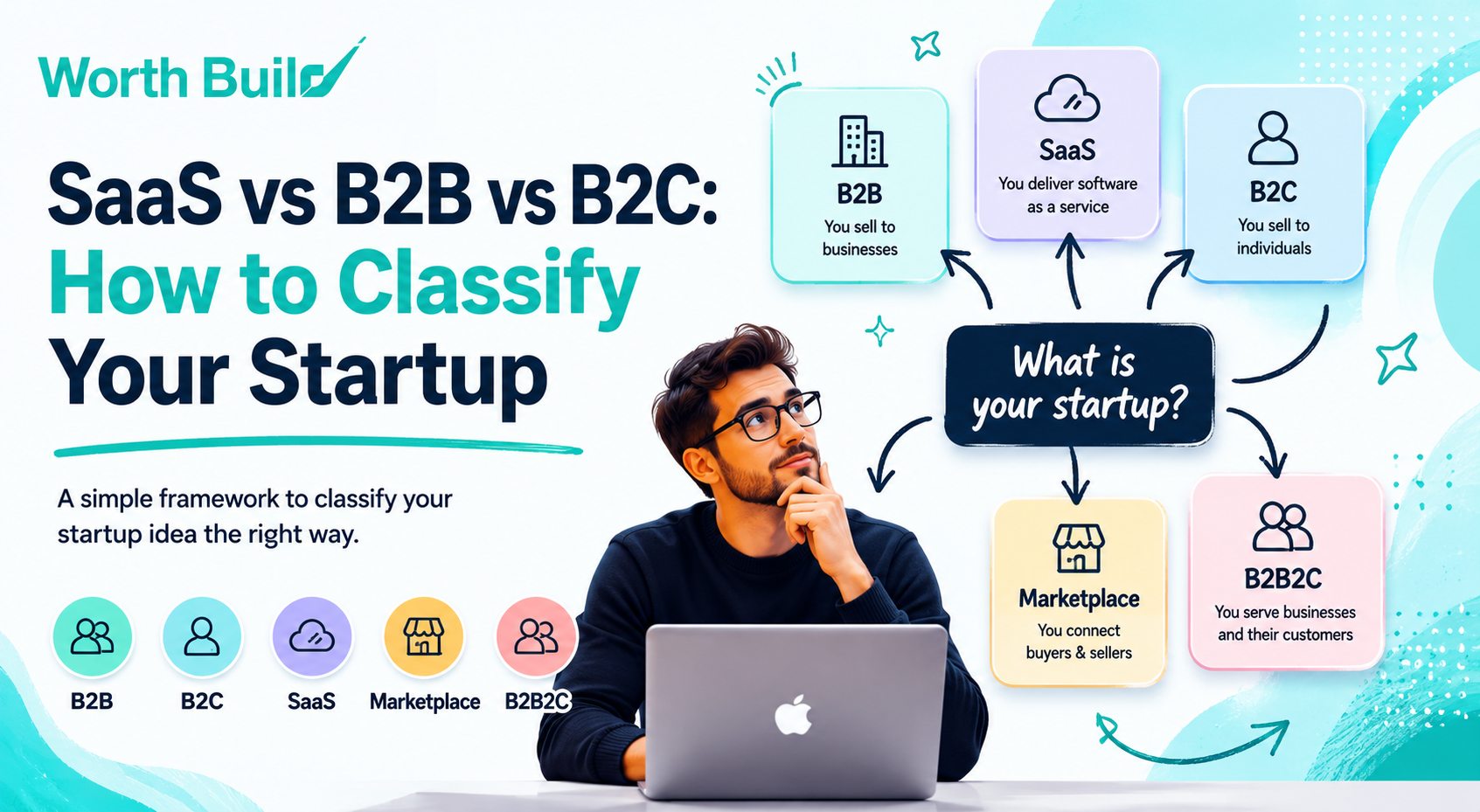
Ask ten founders what kind of company they're building, and you'll hear answers like "a B2B SaaS," "a B2C marketplace," or — most often — a confident "it's a SaaS." Then ask a follow-up question or two, and the answer falls apart.
That's because "SaaS vs B2B vs B2C" is a trick question. These three labels don't belong on the same list. Getting your classification right isn't about sounding smart in a pitch — it decides how you price, where you find your first customers, which metrics investors will judge you on, and how you size your market.
This guide gives you a simple way to classify any startup idea correctly, including the awkward in-between cases (B2B2C, marketplaces, and prosumer), plus a decision tree you can run in about two minutes.
The mistake almost every founder makes
Here's the core idea, and it's the thing most articles skip:
B2B and B2C answer one question. SaaS answers a completely different one.
- B2B vs B2C (and B2B2C) describes who your customer is.
- SaaS describes how you deliver your product and make money.
- Marketplace describes how your business is structured — you connect other people who transact.
They're different axes. So you don't pick "SaaS or B2B or B2C." You classify your startup on both axes, and the combination is what tells you how to run the business.
A quick gut-check with companies you know:
- Slack is B2B (who) + SaaS (how).
- Netflix is B2C (who) + subscription, not "SaaS" in the business-tool sense.
- Airbnb is mostly B2C (who) + marketplace (how).
- Figma started as prosumer (individuals) and grew into B2B SaaS (teams).
Once you separate "who" from "how," the confusion disappears. Let's take each axis in turn.
Axis 1 — Who is your customer?
B2B (Business-to-Business)
You sell to companies, teams, or organizations. A few defining traits:
- The buyer is often not the user (a manager buys the tool; employees use it).
- Fewer customers, higher prices, longer sales cycles, relationships, and trust matter.
- Growth tends to come from sales, partnerships, and founder-led selling early on.
Examples: Salesforce, Stripe, Slack, HubSpot.
B2C (Business-to-Consumer)
You sell to individuals for their personal use.
- Many customers, lower price per customer, fast (often emotional) buying decisions.
- Brand, distribution, and word-of-mouth/virality matter more than sales reps.
- Growth comes from paid acquisition, content, app stores, and referrals.
Examples: Netflix, Duolingo, Calm, Spotify.
B2B2C (Business-to-Business-to-Consumer)
You sell through a business to reach its consumers. You effectively have two customers: the partner who pays for or integrates your product, and the end consumer who actually uses it. You have to win both.
Examples: Affirm (it serves merchants and the shoppers at checkout), white-label apps, embedded-payments or buy-now-pay-later providers.
One more you might hit: B2G (selling to government). Treat it as a stricter, slower version of B2B with procurement rules.
Axis 2 — How do you deliver and make money?
SaaS (Software as a Service)
Software you host, sold as a recurring subscription. Revenue shows up as MRR/ARR, and the metrics that matter are churn, retention, CAC, and LTV. Crucially, SaaS can be either B2B or B2C — that's exactly why it sits on a different axis.
Marketplace
You don't sell your own product — you connect two sides (buyers and sellers, riders and drivers) and take a cut. Your hardest problem is the "chicken-and-egg" of getting enough supply and demand at once. The numbers that matter are GMV (gross merchandise value), take rate, and liquidity.
Examples: Airbnb, Uber, Etsy, Faire.
Transactional / e-commerce / one-time
You sell physical or digital goods, or one-off purchases. No subscription lock-in, so repeat purchase rate and margin per order drive the business.
Prosumer (the one founders forget)
The blend of B2C and B2B. You sell to individuals, but those individuals are professionals or power users adopting your tool for work — often expensing it later, or pulling in their whole team.
- You market like B2C (anyone can sign up, self-serve, no sales call).
- You increasingly monetise like B2B (paid seats, team plans, admin features).
- Growth is bottom-up: one person adopts it, loves it, and brings the company along. This is the engine behind "product-led growth."
Examples: Notion, Figma, Canva (in its early days), Superhuman.
Putting the two axes together
Here's the part that actually answers "what is my startup?" — you state your answer on both axes:
Who (Axis 1) | How (Axis 2) | What you'd call it | Real examples |
|---|---|---|---|
B2B | SaaS | B2B SaaS | Salesforce, Slack |
B2C | Subscription/SaaS | B2C subscription | Netflix, Duolingo |
B2B | Marketplace | B2B marketplace | Faire, Ankorstore |
B2C | Marketplace | B2C marketplace | Airbnb, Etsy, Uber |
Individual → Team | SaaS | Prosumer SaaS | Figma, Notion |
Business → Consumer | SaaS/Platform | B2B2C platform | Affirm, white-label apps |
Notice that "SaaS" appears next to B2B, B2C, and prosumer. That's the whole point.
The 2-minute decision tree
Run your idea through these questions in order. Your answers combine into your classification.
1. Who pulls out the credit card — a company budget, or an individual's own wallet?
Company budget → lean B2B.
Individual wallet → lean B2C.
2. Is the person who pays the same as the person who uses it?
Different people inside one company, like a manager buying for employees → still B2B.
A business pays or enables the product, but consumers use it → B2B2C.
3. Do you sell your own product, or do you connect other people who transact?
You sell your own software, service, or product → continue to the next question.
You connect two sides and take a cut → marketplace.
4. How do you charge?
Recurring subscription for software you host → add the SaaS layer.
Per transaction or one-time purchase → transactional / marketplace.
5. Who adopts you first — an individual power user who later brings their team?
Yes → you have a prosumer motion: you market like B2C, but monetize like B2B.
No → classify based on who pays, who uses it, and how you charge.
Example output:
An individual pays, it's a recurring software subscription, and it spreads from one user to their team → Prosumer SaaS with a product-led growth motion.
Why your classification changes everything
This isn't an academic exercise. Each label points you at different decisions:
- Market sizing. B2B TAM ≈ number of companies × annual contract value. B2C TAM ≈ number of people × price. Marketplace TAM ≈ total transaction volume × take rate. Use the right formula or your numbers will be meaningless — see What Is a Good TAM for a Startup? and the free Market Size Calculator.
- Go-to-market. B2B leans on sales and founder-led outbound; B2C on paid and organic distribution; prosumer on self-serve and product-led growth; marketplaces on seeding one side of supply or demand first.
- Pricing. Per-seat, usage-based, freemium, or a take rate — your model dictates the menu.
- Metrics investors expect. B2B: ACV, net revenue retention, logo retention, pipeline. B2C: retention curves, DAU/MAU, CAC payback. Marketplace: liquidity, take rate, repeat rate.
- Your fundraising story. Investors pattern-match to category benchmarks. A B2C metric in a B2B pitch (or vice versa) signals you don't yet understand your own business.
For a deeper dive into the strategic differences once you've classified, see WorthBuild's B2B SaaS vs B2C SaaS breakdown, and map the whole thing on one page with the Business Model Canvas guide.
Classify these 10 startups (quick reps)
Test yourself — cover the right column first:
Startup | Classification |
|---|---|
Slack | B2B SaaS |
Stripe | B2B SaaS / infrastructure |
Airbnb | B2C marketplace |
Notion | Prosumer → B2B SaaS |
Shopify | B2B SaaS (with ecosystem/marketplace) |
Duolingo | B2C subscription |
Faire | B2B marketplace |
Affirm | B2B2C (fintech) |
Etsy | B2C marketplace |
Figma | Prosumer → B2B SaaS |
How to validate once you've classified
Your classification tells you exactly where your first customers are and how to reach them. If you're B2B, you need the decision-makers and the people feeling the pain. If you're B2C or prosumer, you need the individuals already complaining about the problem in communities.
That's the part WorthBuild handles for you: describe your idea, and it scans Reddit, Hacker News, X, and niche forums to surface real people actively discussing your problem — with ready-to-send outreach messages — alongside a full validation report (market size, competitors, unit economics, and a Go / Pivot / Stop verdict). Useful no matter which box you land in.
Validate your idea with real demand — free. Describe your idea and get your first potential customers in about 2 minutes. Find my first customers → · or get a no-signup Idea Score first.
FAQ
Is my startup B2B or SaaS? It can be both — they're different questions. "B2B vs B2C" is who you sell to; "SaaS" is how you deliver and charge. Most software startups are "B2B SaaS" or "B2C SaaS."
Can a startup be both B2B and B2C? Yes. Sometimes you genuinely serve two segments, and sometimes you're really B2B2C — selling through a business to reach consumers. If so, plan to win two customers, not one.
Is a marketplace a type of SaaS? Usually not. A marketplace connects buyers and sellers and earns a take rate, while SaaS sells subscription software. Some marketplaces add SaaS tools for their sellers, which makes them hybrids.
What is "prosumer" in simple terms? Individuals using professional-grade tools, often for work. You acquire them like consumers (self-serve signup) but increasingly monetise them like businesses (team plans and seats). Figma and Notion are classic examples.
Does my classification change over time? Often, yes. Many startups begin prosumer or B2C and move upmarket into B2B as they add team and enterprise features. Re-check your classification at each stage — it should drive your pricing and metrics.