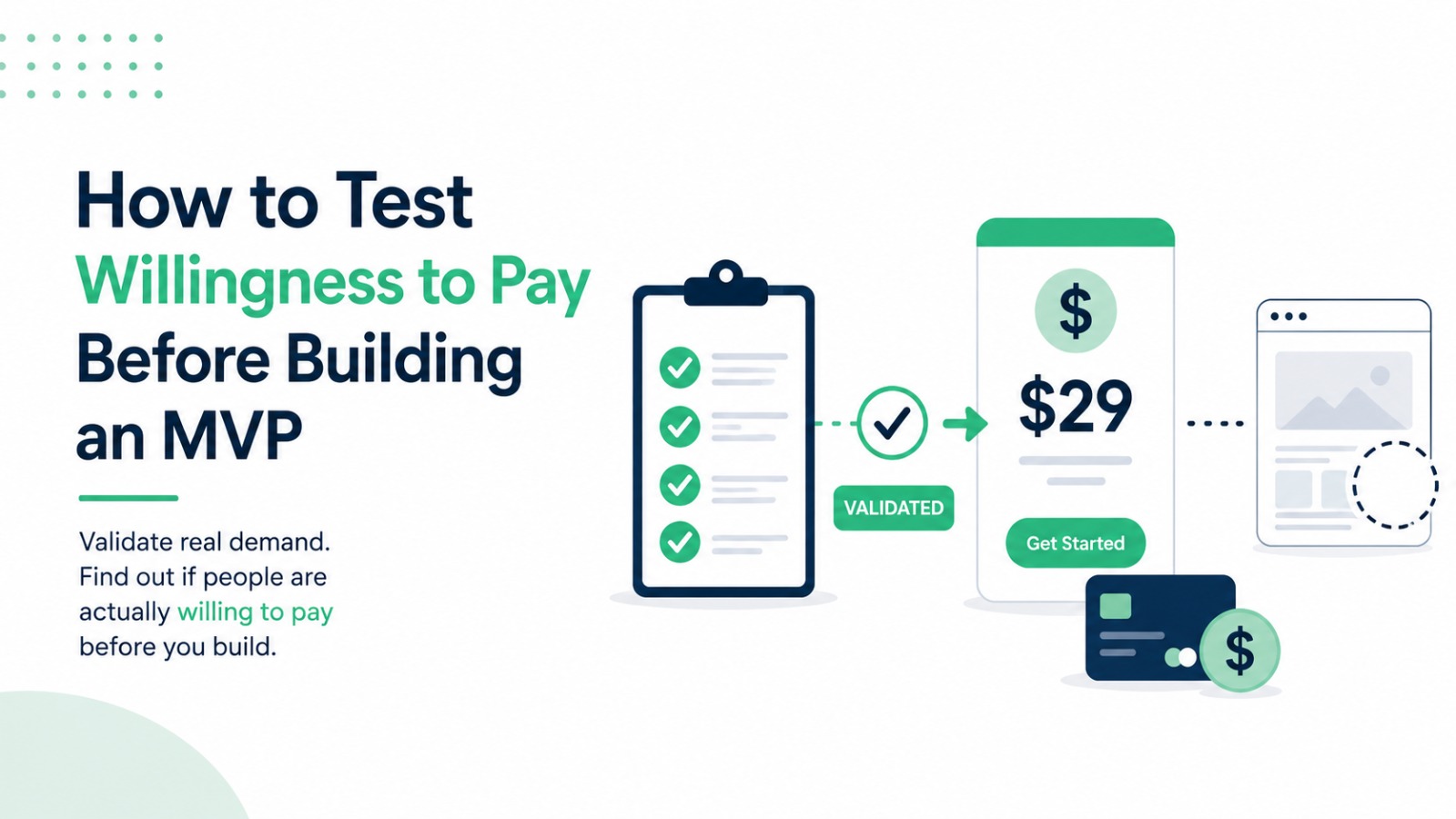
Most founders do not fail because nobody compliments their idea. They fail because compliments are easy and payment is hard.
A potential customer can say, 'This is interesting,' 'I would use this,' or even 'Let me know when it launches' without changing their priorities, budget, workflow, or behavior. Willingness to pay is a stronger signal. It asks a more uncomfortable question: if this existed, would the customer give up money, time, internal approval, or another tool to get it?
That question matters before you build an MVP. An MVP is supposed to reduce risk, not become the first expensive guess in a long chain of guesses. Before writing code, founders should test whether the problem is painful enough, whether the target customer has budget, and whether the proposed solution is valuable enough to justify a transaction.
This guide explains how to test willingness to pay before building an MVP, how to separate weak interest from real buying intent, and which validation signals should make you move forward, change the offer, or stop.
What willingness to pay really means
Willingness to pay is the highest price a customer is prepared to pay for a product, service, or outcome. For early-stage founders, the number itself is not the only thing that matters. The behavior around the number matters too.
A founder testing willingness to pay is not just asking, 'What price sounds reasonable?' They are testing whether the customer recognizes the problem, cares enough to solve it soon, has access to budget, believes the proposed solution can work, and is willing to take the next buying step.
That next step can look different depending on the business model. For a SaaS product, it may be a paid pilot or annual pre-order. For a marketplace, it may be a deposit or signed supply commitment. For a service business, it may be a paid discovery engagement. For a consumer product, it may be a pre-order, checkout attempt, or paid reservation.
The mistake is treating all interest as equal. It is not.
Interest vs intent vs payment
Before you run any test, separate your signals into three levels:
Signal level | What it looks like | How strong it is |
Interest | Likes, compliments, survey answers, free waitlist signups. | Weak |
Intent | Books a call, asks about price, compares alternatives, requests a demo. | Medium |
Payment | Pays a deposit, pre-orders, signs a paid pilot, or commits budget. | Strong |
Interest is useful, but it is the weakest layer. Intent is better because the customer gives time or attention to a buying process. Payment is the strongest because it forces a real tradeoff.
If your validation only produces interest, you have a reason to keep learning. If it produces intent, you may have a reason to design an MVP. If it produces payment or a serious budget commitment, you have a much stronger reason to build.
Why asking "would you pay?" is not enough
The direct question sounds logical: 'Would you pay for this?' The problem is that people often answer based on politeness, imagination, optimism, or the desire to be helpful. They are not actually making a purchase decision in that moment.
A better test creates a realistic decision. Instead of asking whether someone might pay someday, show a specific offer, attach a specific price, explain what happens next, and ask for a real action.
Weak vs. strong testWeak question: Would you pay $29 per month for this? |
The second version is harder to say yes to casually. That is the point.
Step 1: Start with the painful problem, not the feature list
Willingness to pay starts with pain. Customers do not buy features because a founder thinks they are clever. They buy outcomes: less wasted time, more revenue, lower risk, better compliance, fewer errors, faster work, clearer decisions, or higher status.
Before testing price, define the problem in one sentence:
[Target customer] struggles with [expensive or urgent problem] because [current workaround or failed alternative], which causes [measurable cost].
If the problem cannot be tied to time, money, risk, or urgency, willingness to pay will usually be weak. That does not mean the idea is bad, but it means the value proposition needs sharper proof before you build.
Step 2: Identify who owns the budget
Many validation tests fail because founders interview users who feel the pain but cannot approve payment. This is especially common in B2B.
A junior employee may love your productivity tool, but the department head owns the budget. A developer may want your API, but procurement controls vendor approval. A founder may want a tool, but the company may still be too early to pay for another subscription.
Before testing willingness to pay, write down three roles:
- The user: feels the pain and uses the product.
- The buyer: controls or approves budget.
- The champion: cares enough to push the solution internally.
In early validation, try to speak with all three when possible. If you only speak with users, you may validate pain without validating revenue.
Step 3: Use a pricing page before the product exists
A simple landing page with pricing is one of the fastest ways to test willingness to pay. The page does not need a finished product. It needs a clear promise, a believable explanation of what the customer gets, pricing options, and a call to action that reveals intent.
The mistake is hiding the price behind 'Join the waitlist.' A waitlist can measure curiosity, but it does not test payment. If you want to know whether people will pay, show the price.
Track the full funnel: visitor to pricing-page view, pricing-page view to CTA click, CTA click to booked call or checkout attempt, and booked call to paid commitment.
Use one of these calls to action:
- Reserve early access
- Start with a paid pilot
- Pre-order now
- Request an implementation call
- Join the founding customer program
Step 4: Run a fake-door test ethically
A fake-door test measures whether users click on or request a feature before it is built. For willingness to pay, the fake door can be a pricing plan, paid upgrade, pre-order button, or pilot application.
The ethical rule is simple: do not trick people into thinking they paid for something that exists if it does not. When they click, tell them the product is not ready yet and offer a clear next step, such as joining the founding customer list, booking a call, or getting a refund if you collected a reservation deposit.
A good fake-door test answers: Are people interested enough to click when a price is visible? Which segment clicks most? Which promise creates stronger intent? Which price point causes the biggest drop-off?
Before you build, you can use WorthBuild to find real people already discussing the problem and test pricing with better leads.
Step 5: Offer a paid concierge MVP
A concierge MVP solves the problem manually before the software exists. This is one of the clearest ways to test willingness to pay because the customer pays for the outcome, not the interface.
For example, instead of building an automated customer research platform immediately, a founder could manually find 25 qualified leads, write outreach messages, and deliver a validation report for a small fee. If customers pay for the manual version, the founder learns which parts are valuable enough to automate.
This approach also reveals hidden product requirements. Manual delivery gives you those insights before product decisions become expensive.
Step 6: Test paid pilots for B2B ideas
For B2B startups, a paid pilot is often stronger than a pre-order. A buyer may not want to pay for a product that does not exist yet, but they may pay for a limited pilot that solves one urgent workflow.
Do not let the pilot become unpaid consulting. If the customer has a serious problem and budget, they should be willing to pay something.
A good paid pilot has a narrow scope:
- One customer segment
- One urgent problem
- One measurable success metric
- One short timeline, often 2 to 6 weeks
- One clear next step if the pilot works
To check whether the pilot can support a real business model, compare your expected price against customer value with WorthBuild’s LTV Calculator, CAC Calculator, and Break-Even Calculator.
Step 7: Use letters of intent carefully
A letter of intent can be useful, but it is weaker than cash. Some founders treat LOIs as if they were revenue. They are not.
An LOI is useful when it includes specific buying conditions: who the buyer is, what problem the product must solve, what price range is acceptable, what timeline matters, what success criteria must be met, and what happens after the MVP or pilot is delivered.
A vague LOI that says a company is 'interested in exploring the solution' is only a soft signal. A detailed LOI with a budget owner, timeline, and pilot terms is much stronger.
Step 8: Test price sensitivity without pretending surveys are purchases
Pricing surveys can help you understand how customers think about value, but they should not be treated as proof that customers will buy. Use them to generate hypotheses, then test those hypotheses with behavior.
Two common pricing research methods are Van Westendorp and Gabor-Granger. These methods can help you find a reasonable price range, but early founders should combine them with real-world actions: checkout attempts, deposit requests, sales calls, paid pilots, or pre-orders. A stated price preference is a clue. A transaction is evidence.
What counts as a strong signal?
There is no universal conversion rate that proves every startup idea is worth building. Instead of looking for one magic benchmark, look for signal quality.
Strong signals include:
- A customer pays before the full product exists.
- A buyer asks for legal, security, onboarding, or implementation details.
- A prospect compares your offer to an existing paid alternative.
- A customer introduces you to the budget owner.
- A company agrees to a paid pilot with success criteria.
- A segment responds consistently to the same pain and offer.
- Customers object to details, not to the existence of the problem.
Weak signals include likes, compliments, vague survey answers, free waitlist signups, friends saying they would use it, or people asking for updates but avoiding price.
A simple scoring framework
Use this scoring model after your first 20 to 50 customer conversations or after a small landing-page test.
Signal | Weak | Medium | Strong |
Problem pain | Nice-to-have | Clear frustration | Urgent and costly |
Current workaround | None | Manual workaround | Paid alternative or painful process |
Budget access | Unknown | User can influence | Buyer involved |
Price reaction | Avoids price | Negotiates price | Accepts range or asks next steps |
Commitment | Waitlist only | Demo or LOI | Pre-order, deposit, or paid pilot |
Segment clarity | Mixed audience | Some pattern | Repeatable ICP |
If most signals are weak, do not build yet. Revisit the problem, segment, or offer. If most signals are medium, run a sharper test with pricing and a real buying action. If several signals are strong, you may have enough evidence to build the smallest MVP that fulfills the paid promise.
If the signal looks strong but the market opportunity is still unclear, use WorthBuild’s Market Size Calculator or read the guide on calculating SOM before deciding how much of the opportunity is realistically obtainable.
Common mistakes to avoid
- Testing with friends: Friends are useful for encouragement, not buying evidence.
- Hiding the price: If you hide the price, you are testing interest, not willingness to pay.
- Treating a waitlist as revenue validation: A waitlist is a top-of-funnel signal. It does not prove that people will pay after launch.
- Selling too broad of a promise: Narrow the offer to one customer, one painful problem, and one measurable result.
- Building the full MVP after one positive call: One enthusiastic prospect is not a market.
When should you build the MVP?
Build the MVP when you know the customer, the problem, the buying trigger, and the first paid use case. The MVP should not be a broad product. It should be the smallest version that delivers the outcome customers already agreed is worth paying for.
WorthBuild ruleDo not build to discover whether people care. Build after you have enough evidence that a specific group cares enough to act. |
How WorthBuild helps before you build
Willingness to pay depends on finding the right people, not just writing a better survey. The real question is: are there people already talking about this problem and looking for a solution?
WorthBuild answers that question before you build. Describe your idea, and WorthBuild scans Reddit, Hacker News, Twitter, and relevant communities to surface real people who are actively discussing the exact problem your idea solves. Each lead comes with pain points, engagement signals, and a ready-to-send personalized outreach message - so you can start real customer conversations from day one.
Every report also includes market validation, TAM/SAM/SOM, competitor mapping, risk assessment, unit economics, and a Go / Pivot / Stop verdict. Use those leads to run outreach, book paid discovery calls, test a landing page with real pricing, or offer a pilot.
The goal is to move from “people like the idea” to “these customers are taking buying actions.” For more tactical outreach, read WorthBuild’s guide on finding your first customers on Reddit.
Find your first customers free - no credit card required. |
Final takeaway
Willingness to pay is the difference between validation that feels good and validation that reduces risk.
Before building an MVP, test whether the problem is painful, whether the buyer has budget, whether the offer is clear, and whether the customer will accept real friction to get the outcome. Start with conversations, but do not stop there. Add pricing pages, fake-door tests, paid pilots, concierge delivery, pre-orders, and specific buying commitments. Then score your idea before you invest more time in building.
The best MVP is not the first thing you build. It is the smallest thing worth building after customers have already shown that the outcome is worth paying for.
FAQ
What is willingness to pay in startup validation?
Willingness to pay is evidence that a customer values your solution enough to exchange money, budget approval, time, or switching effort for it. For startups, it is stronger than compliments, surveys, or free waitlist signups.
How do you test willingness to pay before building an MVP?
Use pricing pages, pre-orders, paid pilots, fake-door tests, concierge MVPs, deposit requests, and budget-owner interviews. The goal is to create a realistic buying decision before spending months building.
Is a waitlist proof that people will pay?
No. A waitlist proves interest, not payment intent. It becomes more useful when paired with pricing, a paid reservation, a pilot offer, or follow-up conversations that involve budget.
Should I ask customers how much they would pay?
You can ask, but do not rely on the answer alone. Direct pricing questions can be biased. Combine survey answers with real behavior such as checkout attempts, deposits, or paid pilots.
How many pre-orders or paid pilots do I need before building?
There is no universal number. A few high-quality B2B paid pilots can be stronger than hundreds of low-intent consumer signups. Look for repeated buying behavior from a clear customer segment.