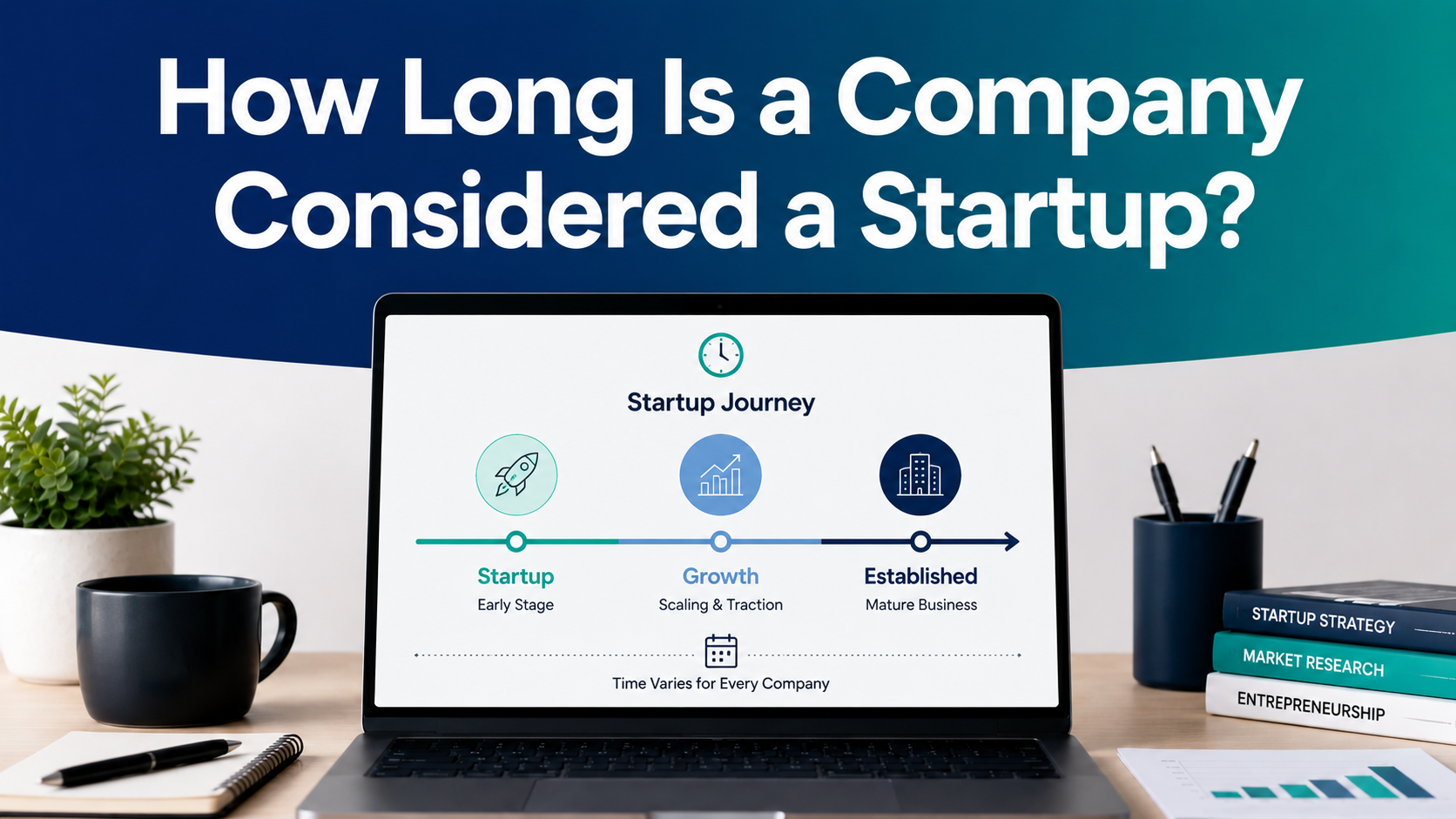
"How long is a company a startup — three years? Five? Ten?"
It's one of the most-searched startup questions, and the honest answer is: age is the worst way to define a startup. Plenty of eight-year-old companies are still very much startups. Plenty of two-year-old businesses never were.
What actually makes a company a startup is what it's doing: searching for a repeatable, scalable business model under real uncertainty. Once you understand that, you can place your own company accurately — and know when it stops being a startup.
The short answer: it's not about age
You'll see plenty of time-based rules of thumb — "a startup is under 3 years old," "5 years," or "until it hits $X in revenue or Y employees." These are fine as rough signals, but they break constantly:
- A profitable local agency at year two executing a known playbook is a small business, not a startup.
- A deep-tech company eight years into building something genuinely new, still searching for a scalable model, is absolutely a startup.
So define your company by stage and behaviour, not by its birthday.
The real definition of a startup
The most useful definitions come from people who built the field. Steve Blank describes a startup as a temporary organisation in search of a repeatable and scalable business model. Eric Ries frames it as building something new under conditions of extreme uncertainty. Strip those down and three words matter:
- Searching — you haven't yet locked in a proven, repeatable way to make money. (A small business is executing a model that already works.)
- Scalable — you're built to grow revenue much faster than costs.
- Uncertainty — it's still a genuine open question whether this will work.
A bakery on the corner has a known model and limited scalability — a fine business, not a startup. A company hunting for a model it can scale 100x is a startup, whatever its age.
The signals that actually define a startup
No single metric decides it. Look at these together.
1. Growth stage
Startups move through stages: idea → MVP → early traction → product-market fit → scale. You're clearly a startup while you're climbing toward, and just past, product-market fit — still proving people want this and will keep paying. (Not sure where you stand? See What Is Product-Market Fit and How to Measure Your PMF Score.)
2. Scalability
Can your revenue grow far faster than your costs? Startups are usually built on something that scales — software, network effects, a model that doesn't need a new hire for every new customer. If growth requires adding people or locations in a straight line, you may be running a healthy SMB rather than a startup.
3. Funding stage
Funding stage is a strong proxy for where you are:
- Bootstrapped / pre-seed / seed / Series A → clearly startup territory.
- Series B–C and beyond → usually a "scale-up" — growing fast on a model that's largely proven.
(New to this? The Pre-Seed Funding Guide for First-Time Founders walks through the earliest stage.)
4. Business model maturity
Are you still testing pricing, channels, and customer segments? That experimentation is the heart of being a startup. Once you have a predictable, repeatable revenue engine — you know what you spend to acquire a customer and what they're worth — you're graduating.
5. Team size and structure
Small, flat, cross-functional teams where everyone wears several hats = startup. Once you have formal departments, layers of management, and hundreds of employees, the startup phase is usually behind you. (These are rough signals, not hard lines — culture can lag structure either way.)
6. Uncertainty and risk
High existential uncertainty — will this even work? — is a defining startup trait. Stable, predictable operations with a clear path forward point to a more mature company.
When a company stops being a startup
There's no single moment, but when several of these are true at once, you've likely graduated:
- Durable product-market fit and predictable, repeatable revenue.
- Growth is now a function of execution, not discovery — you're scaling a known model, not searching for one.
- Profitability, or a clear and reliable path to it.
- Significant scale in revenue and headcount, with formal structure and process.
- A liquidity event (IPO or acquisition) or clear market leadership.
In between "startup" and "established company," most people use the term scale-up. And yes — many large private "startups" (including unicorns) are really scale-ups by this definition; the label sticks around for brand reasons long after the search for a model is over.
Why the label actually matters
This isn't just semantics — it changes real decisions:
- Eligibility. Accelerators, grants, startup visas, and certain tax schemes often have age or stage criteria.
- Investor expectations. A startup is judged on growth and potential; a mature company on profit and stability. Pitch yourself in the wrong frame and you'll be measured by the wrong yardstick.
- Hiring and equity. Your stage shapes compensation, equity packages, and the kind of people you can attract.
- Your own strategy. Knowing you're still searching (not yet executing) keeps you focused on the right job: proving demand and reaching product-market fit, instead of scaling prematurely — one of the most common ways startups die. (See Why 90% of Startups Fail Before They Write a Single Line of Code.)
A 60-second self-check
Answer honestly:
- Are you still searching for a repeatable, scalable business model?
- Is your business built so revenue can outpace costs?
- Are you roughly pre-seed to Series A?
- Is your team small and flat, with everyone wearing multiple hats?
- Is there still real uncertainty about whether this works?
Mostly "yes" → you're a startup. Mostly "no" → you've probably graduated to a scale-up or established company (or you're running a small business — which is a great thing to be, just a different game).
Whatever stage you're at, demand comes first
The one thing that's true at every stage: you have to keep proving that real people want what you're building. If you're at the start — or sizing up your next idea — that means getting real demand signals before you invest months of work.
That's exactly what WorthBuild does: describe your idea and, in about two minutes, it finds real people already discussing the problem you solve (with outreach messages), plus a full report on market size, competitors, and whether to go, pivot, or stop.
Test your idea against real demand — free. Validate my idea with WorthBuild → · or get a no-signup Idea Score in 2 minutes.
FAQ
How many years is a company considered a startup? There's no fixed number. People often say three to ten years, but stage matters far more than age — a company is a startup as long as it's searching for a repeatable, scalable model under uncertainty.
Is a company with revenue still a startup? Yes. Having revenue doesn't end startup status. What signals graduation is predictable, repeatable, scalable revenue plus product-market fit — not the first dollar through the door.
When does a startup become a scale-up? Roughly once it has product-market fit and is growing fast on a proven model — often around Series B and beyond, when the job shifts from discovery to execution.
Can a 10-year-old company still be a startup? Yes, though it's less common. If it's still searching for a scalable model under high uncertainty (common in deep tech, biotech, or hardware), it qualifies — age alone doesn't disqualify it.
Is my small business a startup? Only if it's built to scale and is still searching for a repeatable, scalable model. A stable business executing a known, location- or labour-bound model is a small business — not a startup, and that's perfectly fine.