Every week, thousands of founders pour their life savings into products nobody wants. They quit their jobs. They write the code. They build the landing page. And then they launch into silence.
The uncomfortable truth? The failure didn't happen at launch. It didn't happen during development. It happened at the moment they skipped validation and decided to just build.
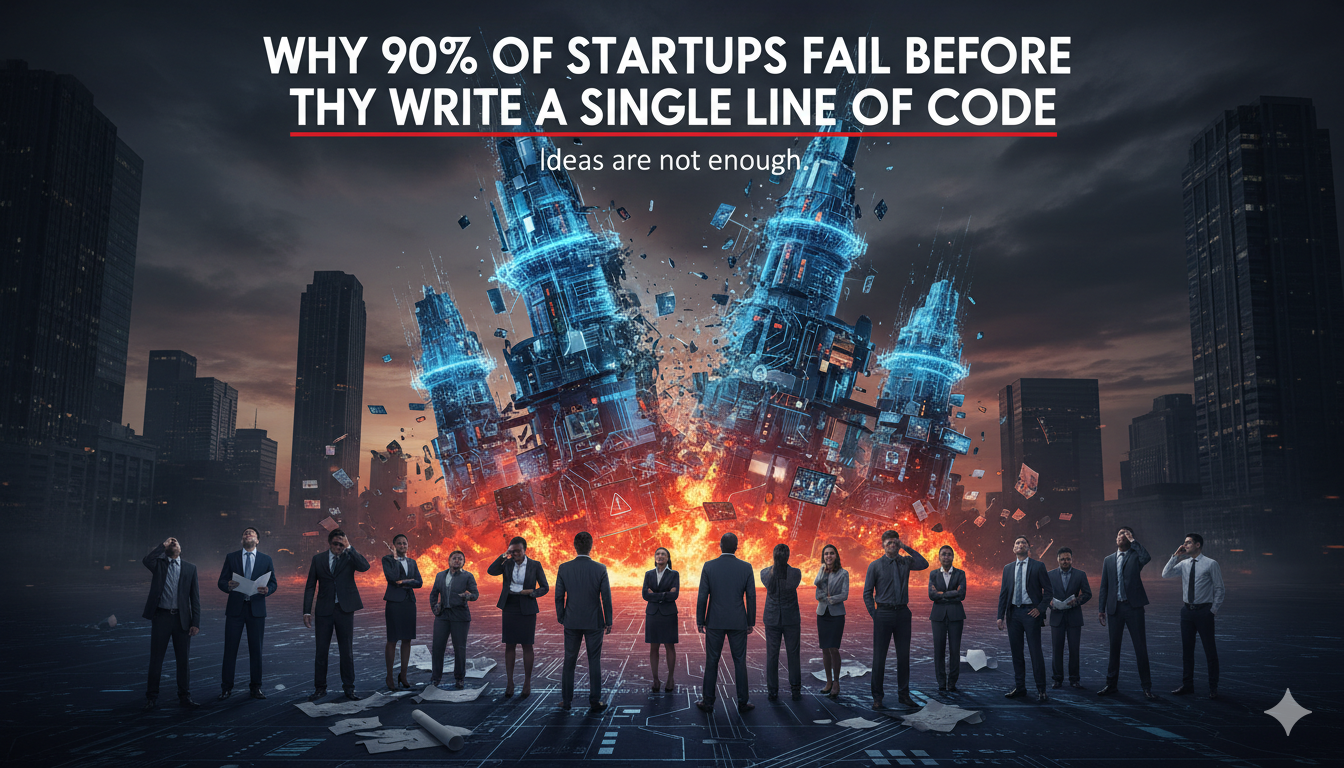
You've probably heard that 90% of startups fail. But here's the statistic that should keep every founder up at night: 42% of startups fail specifically because there was no market need for their product. Not bad code. Not poor marketing. Not the wrong co-founder. They built something nobody wanted — and they never checked first.
This article is about how to be in the other 10%. It's about what real validation looks like, what it costs to skip it, and the exact 5-step process you can use to know whether your idea is worth building — before you write a single line of code.
42%
of startups fail due to no market need for their product (CB Insights, 2025)
The "Build It and They'll Come" Fallacy
There's a romantic narrative in startup culture. The lone genius. The garage. The product that changes the world because it's simply too good to ignore. Movies are made about it. Podcasts celebrate it. And it quietly destroys founders every single day.
The 'build it and they'll come' mindset is seductive because it feels like confidence. It feels like conviction. But conviction about the wrong thing isn't a virtue — it's expensive.
Consider what actually happens when founders skip validation:
- They spend 4–6 months building a product based on a hunch.
- They launch to an audience of zero because they never found customers first.
- They discover that their "unique" idea has 12 competitors they never researched.
- They run out of runway trying to pivot after the fact.
CB Insights analyzed hundreds of failed startups and found the top reasons they shut down. No market need topped the list at 42%. Running out of cash came second at 29% — often a direct consequence of building the wrong thing for too long.
The saddest part? Most of these failures were preventable. The data was there. The market signals existed. The founders just never looked.
Real Talk Most founders know, somewhere deep down, that they're building on assumption. They just hope the assumption is right. Hope is not a validation strategy. |
What Real Validation Actually Looks Like
Ask ten founders how they validated their idea and you'll get ten versions of the same non-answer:
- "I talked to some friends. They thought it was great."
- "I Googled it. Nobody else is doing it."
- "I just know there's a market. I feel it."
This isn't validation. This is confirmation bias wearing a lab coat.
Real startup idea validation answers five specific questions with data, not feelings:
Question 1: Is there demonstrated demand for this?
Not "would you use this" from your friends. Real demand means: are people actively searching for this solution, discussing the problem online, and paying for adjacent products? Search volume, Reddit threads, and Google Trends are your friends here.
Question 2: Who are your actual competitors?
"There are no competitors" is almost never true. If nobody is solving this problem, the more likely explanation is that no market exists — not that you've discovered an untapped goldmine. Understanding the competitive landscape tells you whether the market is validated and where your opening is.
Question 3: How large is the realistic opportunity?
TAM (total addressable market) sounds impressive in pitch decks. SAM (serviceable addressable market) and SOM (serviceable obtainable market) are what actually matter. A $500B market you can only realistically capture 0.001% of is not the same as a $2B market where you can win 5%.
Question 4: Do the unit economics work?
What will it cost to acquire a customer (CAC)? How much will they spend over their lifetime (LTV)? If your LTV:CAC ratio is below 3:1, you're bleeding money at scale. These numbers need to be estimated before you build, not discovered after you've burned your runway.
Question 5: Can you find real people with this problem right now?
The ultimate validation: can you identify specific human beings who are actively experiencing the problem you're solving? Not a survey. Not a persona. Real people, on Reddit, on forums, on LinkedIn, who are complaining about exactly this issue today.
If you can answer all five with data, you have real validation. If you can't, you have a hypothesis — and those are worth exactly nothing until tested.
The $10K Mistake Most Founders Make
Let's talk about what this actually costs. The average founder spends $40,000 getting a startup off the ground according to Fundera's research on startup capital. But even before the formal launch, the average pre-revenue founder has burned 3–6 months of their own time, often the equivalent of $10,000–$30,000 in opportunity cost.
Here's how that loss typically unfolds:
Month 1–2: Building in stealth.
The idea feels exciting and novel. The founder wants to "get it right" before showing anyone. They hire a designer. Maybe a developer. They iterate on features nobody has asked for yet.
Month 3–4: Almost ready.
"Just one more feature." The product is 80% done but the edge cases keep piling up. The founder reassures themselves: once it's live, users will show them what to fix.
Month 5: Launch.
The product goes live. ProductHunt, some tweets, a Reddit post. 200 visits. 3 signups. 0 paying customers. The feedback that trickles in reveals a fundamental problem: the feature users actually need is completely different from what was built.
Month 6: The pivot.
Now the founder is rebuilding from scratch — with depleted funds, depleted energy, and the sinking feeling that two weeks of proper validation could have saved all of this.
This isn't a hypothetical. It's the story of most startups that fail. And the cruelest part is that the data needed to prevent it was always publicly available. It just needed to be gathered, analyzed, and synthesized before writing a single line of code.
The Real Cost The $10K mistake isn't just the money. It's the 6 months. The opportunity cost. The second-guessing. The conversations you didn't have with customers because you were too busy building. |
How WorthBuild Changed My Approach
After going through the painful cycle above, the team behind WorthBuild built the tool they wished had existed from the start.
The premise is simple: describe your startup idea in plain English, and WorthBuild delivers a complete, data-backed validation report in under two minutes.
Here's what the analysis covers:
- Market Analysis: Market demand signals
- Search trends and competitive landscape
- Green flags and red flags specific to your idea
- Validation Scorecard: Problem validation score
- Market opportunity score
- Solution strength score and overall feasibility rating
- TAM / SAM / SOM: Total addressable, serviceable, and obtainable market
- Financial projections and revenue modeling
- Unit Economics: Customer acquisition cost (CAC) estimate
- Lifetime value (LTV) modeling
- Monetization strategy suggestions
- Technology Assessment: Recommended tech stack
- Development timeline and complexity rating
- Risk Assessment: Technical, market, and financial risks
- Impact and probability indicators for each risk
- Execution Roadmap: Quick wins for Week 1
- MVP plan and 3-month action plan
- Go-to-market suggestions
But the feature that changes everything is Your First Customers. Rather than telling you "the market exists," WorthBuild surfaces real people — actual names, platforms, and discussion threads — who are actively expressing the exact problem your startup solves. You can start real customer conversations on Day 1.
The result is a clear Go / Pivot / Stop verdict backed by real data. Not gut feel. Not friends' opinions. Data.
The free plan validates one idea per month with no credit card required. For founders who are evaluating multiple ideas or need the full customer outreach feature, Pro starts at $9.99/month.
→ Validate your idea for free at worthbuild.io
Your 5-Step Pre-Build Validation Checklist
Whether you use WorthBuild or do this manually, here is the exact process every founder should complete before writing code. Each step should produce a concrete, documented answer — not a feeling.
Step 1: Validate Market Demand (Week 1, Day 1)
Go to Google Trends and search your core problem. Look at 5-year trend direction — is it growing, flat, or declining? Search Reddit, Quora, and Twitter for people complaining about the problem. Find at least 20 real complaints from real people. If you can't find 20 complaints, the problem may not be painful enough to build a business around.
- Google Trends search volume: trending up?
- Reddit/Quora threads: 20+ organic complaints found
- Twitter/X discussions: active conversation?
- Facebook Groups: communities around this problem?
Step 2: Map the Competitive Landscape (Week 1, Day 2)
Search for every direct and indirect competitor. Name at least five. If you find zero, search harder — or reconsider whether the market exists. For each competitor, note their pricing, their main weakness (check their 1-star reviews), and the audience segment they're not serving well. That gap is your entry point.
- 5+ competitors named and documented
- Pricing models compared
- Top 3 customer complaints per competitor (from reviews)
- Your clear differentiation defined in one sentence
Step 3: Calculate Your Real Market Size (Week 1, Day 3)
Don't just say "it's a billion-dollar market." Work the math. Start with the number of potential buyers, multiply by your realistic price point, and constrain it by your ability to reach them. A $50M SAM you can realistically capture 10% of is more valuable than a $10B TAM you'll never touch.
- TAM: total number of potential buyers x average price
- SAM: buyers you can realistically reach with your channels
- SOM: conservative 3-year target (typically 1-5% of SAM)
- Do the numbers justify the effort?
Step 4: Stress-Test Your Unit Economics (Week 1, Day 4)
Map out the financial reality before you build. What will it cost to acquire one paying customer? What will that customer spend with you over 12 months? Over their lifetime? Your LTV should be at least 3x your CAC for the business to be sustainable. If you can't model these numbers, your business model isn't defined enough to build.
- Estimated CAC: paid ads, content, referral, or direct
- LTV: average monthly revenue x average months retained
- LTV:CAC ratio: must be 3:1 or better
- Time to payback CAC: under 12 months?
Step 5: Get a Pre-Launch Commitment (Week 1, Day 5)
This is the final gate. Before you build, reach out to 10 of the real people you found in Step 1 and ask one question: "If I built a tool that solved [X], would you pay $[Y]/month for it?" Getting three people to say yes — not "maybe," not "sounds interesting," but an actual conditional commitment — is stronger validation than any dataset.
- 10 outreach messages sent to real potential customers
- 3+ conditional "yes" responses received
- Specific objections documented for product roadmap
- At least 1 person willing to be a beta tester
If you can check every box in this checklist, you have more pre-launch validation than the majority of funded startups. And if you want all five steps completed in two minutes instead of five days, WorthBuild does exactly that.
Stop Guessing. Start Validating.
The founders who win aren't the ones who build fastest. They're the ones who build the right things — because they did the work to know what the right things were before picking up a keyboard.
Validation isn't pessimism. It isn't lack of confidence. It's the most respectful thing you can do for your own time, your own money, and the customers you're trying to serve.
Every week you spend building the wrong thing is a week you could have spent building something people actually need.
The data is out there. The signals are clear. The only question is whether you'll look at them first.
Ready to validate your idea with real data?
Get your free validation report in 2 minutes — no credit card required.
→ Validate Your Idea Free at worthbuild.io
Frequently Asked Questions
What is startup idea validation and why does it matter?
Startup idea validation is the process of testing whether your idea has real market demand, viable economics, and genuine customer need before investing significant time or money in building it. It matters because 42% of startups fail due to no market need — a problem that proper validation can prevent.
How long does startup idea validation take?
Manual validation using the 5-step checklist above takes approximately 3–5 business days. Using WorthBuild, the core analysis — market demand, competitor landscape, TAM/SAM/SOM, unit economics, and customer identification — is completed in under 2 minutes.
Can I validate a startup idea for free?
Yes. WorthBuild's free plan allows one complete validation per month with no credit card required, including a full report with market analysis, scorecard, financial projections, risk assessment, and execution roadmap.
What's the difference between market research and startup validation?
Market research describes an existing market. Startup validation tests whether your specific solution to a specific problem has enough demand and viability to build a business around. Validation is a subset of market research — more targeted, more actionable, and more directly connected to the go/no-go build decision.
What if my idea scores low in validation?
A low score is valuable data, not a dead end. WorthBuild provides AI-powered pivot suggestions that identify why the idea underperformed and recommend concrete alternatives — different audience segments, adjacent problems, or alternative business models. Many great startups began as pivots from a failed first idea.