In 2026, over 50 million new businesses will be started worldwide. By the time you finish reading this sentence, more than 100 new startups have launched somewhere on the planet.
Most of them will fail.
Not because the founders weren’t smart, hardworking, or passionate. Not because they lacked funding or talent. They will fail because they built something the market didn’t want — and they found out too late.
Idea validation is the discipline that separates the 10% who succeed from the 90% who don’t. It’s not a buzzword. It’s not a formality. It’s the single most high-leverage activity available to any early-stage founder — and most skip it entirely.
This playbook will change that for you.
You’ll get the complete 7-phase validation framework used by experienced founders to eliminate risk before writing a single line of code. Every phase includes what to do, how to do it, what success looks like, and the exact mistakes that kill most validation attempts.
Let’s start at the foundation.
90%
of startups fail — and 42% of those failures cite no market need as the primary cause (CB Insights)
What Idea Validation Actually Is (And What It’s Not)
Before going deep on the framework, let’s get precise about what we’re talking about. Because a lot of founders think they’re validating when they’re actually just reassuring themselves.
The Real Definition
Idea validation is the systematic process of gathering evidence — not opinions, not feelings, not assumptions — that your startup idea has real market demand, viable economics, and a path to paying customers, before you invest significant resources in building it.
Three words matter most in that definition: systematic, evidence, and before. Validation is structured. It’s data-driven. And it happens at the beginning, not after launch.
What Validation Is NOT
❌ Not Validation • Asking friends "what do you think?" • Getting 100 signups on a landing page • Googling "is anyone doing this?" • "I just know there's a market" • Building an MVP and seeing what happens • A survey of 20 people you know • One customer saying they'd pay | ✔ Real Validation • Finding 20+ strangers with the exact problem • Getting 3+ pre-sales from real customers • Mapping 5+ competitors with known revenue • Search volume showing 10K+/mo demand • Unit economics that work at small scale • A market size calculation with real math • Evidence of willingness to pay at your price |
Why Founders Skip It
There are three psychological traps that lead founders to skip validation:
- The Certainty Trap: You believe in your idea so deeply that testing it feels like doubting yourself. But conviction and evidence are not the same thing. The best founders are supremely confident and ruthlessly empirical.
- The Speed Trap: Validation feels slow. Building feels like progress. This is backwards. A week of validation can save four months of building the wrong thing. There is no faster path to a working startup than validating first.
- The Niceness Gap: When you ask people if they like your idea, they say yes. Research from Failory calls this the “niceness gap” — the difference between people who say they’d buy and people who actually do. Friends are especially unreliable validators because they prioritize your feelings over honest feedback.
The Cost of Skipping Validation
Before the framework, let’s make the cost of skipping concrete. Numbers matter here.
The Direct Costs
- Time: The average unvalidated startup wastes 4–6 months before discovering no one wants the product. At a modest $10K/month opportunity cost, that’s $40–60K in lost time.
- Money: Fundera research puts the average startup launch cost at $40,000. Most of that is spent before a single paying customer exists. Validation done properly costs less than $500 and a few days.
- Morale: Launching to silence is psychologically devastating. Many talented founders quit after their first failed launch — not because the next idea would have failed, but because the first failure broke their confidence.
- Opportunity cost: Every month spent building the wrong thing is a month not spent on the right one. The compounding effect of validated ideas moving fast vs. unvalidated ideas spinning in circles is enormous over a 2–3 year window.
A Timeline of the Typical Unvalidated Startup
Month 1–2 | Founder builds in stealth. “I want it perfect before I show anyone.” Features pile up. Costs accumulate. |
Month 3–4 | “Almost ready.” More features added. Scope creep. The simple idea becomes complex. |
Month 5 | Launch. 300 visitors, 8 signups, 0 paying customers. Silence. |
Month 6 | First real customer feedback reveals: the core assumption was wrong. |
Month 7–8 | Pivot attempt. New build begins. Runway depleting fast. |
Month 9–10 | Shutdown or zombie mode. The $40K is gone. |
This is not a hypothetical. It is the story of the majority of startups that launch without validation. The good news: every stage in that timeline has an early warning sign that proper validation would have caught.
The 7-Phase Idea Validation Framework
This framework is built on the combined methodology of lean startup principles, the Jobs-to-be-Done theory (Clayton Christensen), Steve Blank’s Customer Development model, and real-world patterns from studying 100+ startup post-mortems.
Each phase answers a specific question. Complete them in order. Don’t skip ahead. Each phase’s output becomes the input for the next.
1. Define the Problem, Not the Solution Time required: 2–4 hours | Output: A written Problem Statement Most founders start with a solution: “I want to build an app that does X.” This is the first and most common mistake. You need to start with the problem — and the problem needs to be specific, painful, and widespread enough to support a business. The Problem Statement Formula [Specific audience] struggles with [specific problem] which causes [specific painful outcome]. Current solutions fail because [specific gap].
Questions to Sharpen Your Problem Statement
Phase 1 Success Criteria: You can write the problem statement formula above in one paragraph without using the words “app”, “platform”, or “solution.” If you reach for product language, you haven’t found the real problem yet. |
2. Confirm the Problem Exists in the Wild Time required: 4–8 hours | Output: 20+ verified complaint data points Your problem statement is a hypothesis. Now you need to find evidence that real people — strangers, not friends — are actively experiencing and expressing this problem. This is the most skipped step in validation, and the most important. Where to Look
What You’re Looking For Your goal is to collect 20 or more independent data points — posts, comments, reviews, or questions — where people describe the exact problem your idea solves. If you can’t find 20 in a day of searching, one of three things is true:
Phase 2 Success Criteria: 20+ complaint data points documented in a spreadsheet. At least 10 of them use language you hadn’t thought of yourself. If the language surprises you, you’re listening correctly. |
3. Map the Competitive Landscape Time required: 3–6 hours | Output: Competitor matrix with gaps identified "There are no competitors" is almost never true. If you believe your idea has zero competition, you have not looked hard enough — or the market doesn’t exist. Competition is validation. It means the problem is real and people are paying to solve it. How to Find Every Competitor
What to Document for Each Competitor
The Differentiation Test After mapping your competitors, you need to answer this question in one sentence:
Phase 3 Success Criteria: You can name 5 competitors, summarize their weaknesses, and articulate your differentiation in one sentence that no competitor currently claims. |
4. Size the Market (The Right Way) Time required: 2–3 hours | Output: Realistic TAM / SAM / SOM with math "It’s a billion-dollar market" is the most meaningless sentence in any pitch deck. Market sizing only matters when it’s grounded in real numbers that connect to your actual business model. Here’s how to do it correctly. The Three Numbers You Need
Bottom-Up Calculation (Always Preferred)
Three Quick Market Sizing Sources
Phase 4 Success Criteria: A bottom-up SOM calculation that produces a Year 1 ARR number large enough to cover your costs. If the math doesn’t work at 1–5% market capture, either the price is wrong or the market is too small. |
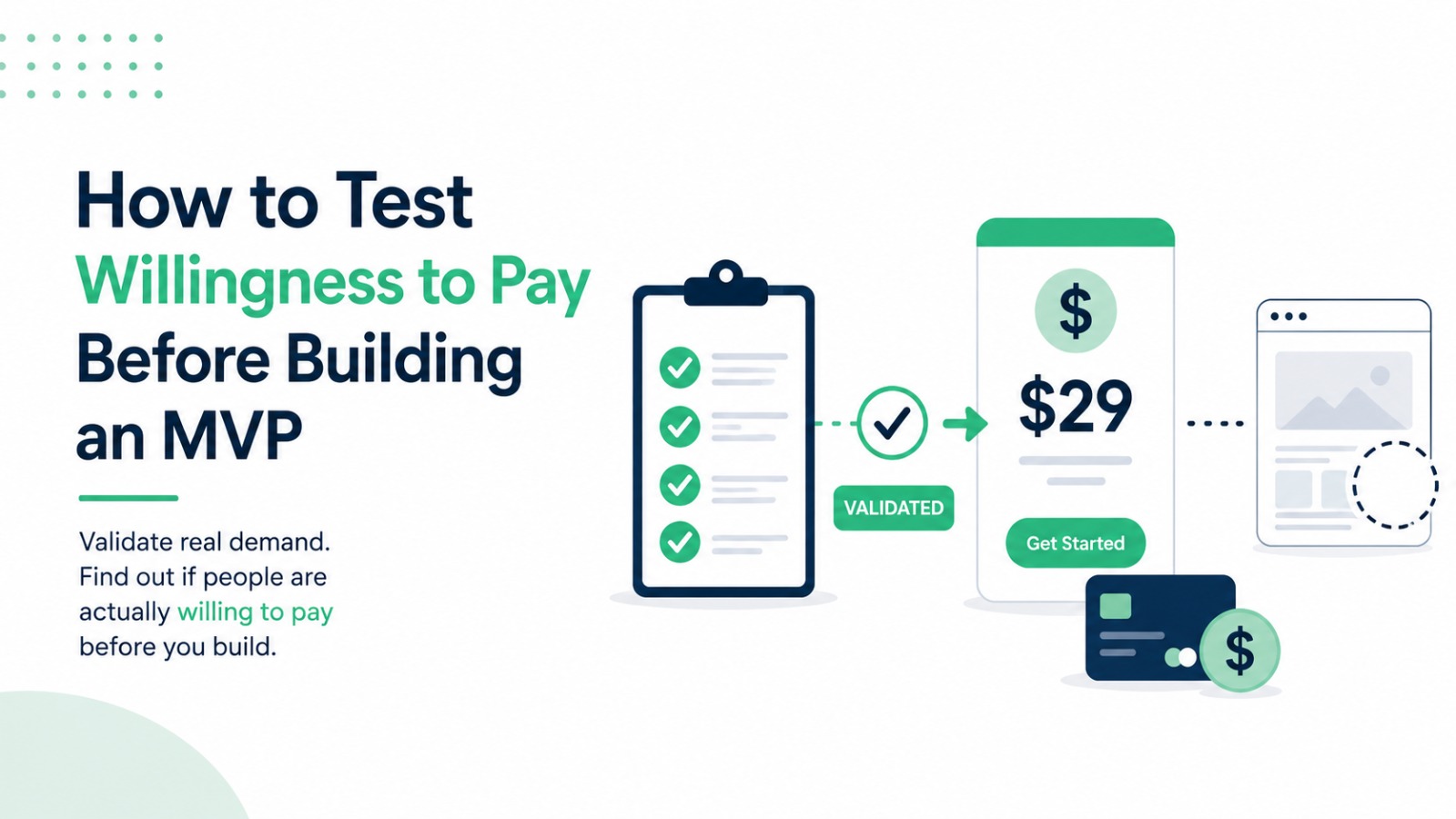
5. Test Demand with a Smoke Test Time required: 3–5 days | Output: Measurable demand signal from strangers A smoke test is a low-cost experiment designed to measure real demand — from people who don’t know you — before building anything. The goal is a measurable signal: clicks, signups, or dollars. The 3 Best Smoke Tests (Ranked by Strength) 🥇 #1 — Pre-Sale (Strongest Signal) Offer to sell the product before it exists at a discounted “early access” price. Set up a Stripe payment link or Gumroad page. If real people pay real money for something that doesn’t exist yet, you have the strongest possible validation signal. What success looks like: 3–10 paying customers at your target price point from people who found you organically or through targeted outreach. 🥈 #2 — Landing Page + Waitlist Build a one-page website that describes your product and its core value proposition. Drive traffic via Reddit posts, LinkedIn content, or a small Google/Meta ad spend ($50–$200). Measure email signups and waitlist conversions. What success looks like: A signup conversion rate above 15% (of visitors to signups) indicates strong messaging-market fit. 🥉 #3 — Problem Interview Find 10–15 people who match your target customer profile (not friends or family). Have a 20-minute conversation focused entirely on the problem, not your solution. Ask: how they currently handle it, how much it costs them, what they’ve tried, what they’d pay to fix it. What success looks like: At least 7 of 10 people describe the exact problem you’ve identified without prompting. At least 3 express strong interest in paying for a solution.
Phase 5 Success Criteria: At least one of the three smoke tests produces a measurable, positive signal from people who have no social obligation to say yes to you. |
6. Validate the Economics Time required: 2–3 hours | Output: Unit economics model with CAC/LTV/payback period A validated market with broken economics is still a dead end. Before you build, you need to confirm that your business model can sustain itself. This doesn’t require a CFO — it requires four numbers. The Four Numbers Every Founder Must Know
How to Estimate CAC Before Launch
Phase 6 Success Criteria: LTV:CAC ratio of 3:1 or better using your most realistic acquisition channel. If the numbers don’t work, you need to raise the price, reduce acquisition cost, or improve retention — before building. |
7. Make the Go / Pivot / Stop Decision Time required: 1–2 hours | Output: A documented, evidence-based build decision After completing Phases 1–6, you have more data about your startup idea than most funded founders have at their Series A. Now it’s time to make the decision — clearly, without emotion, based only on evidence. The Decision Matrix
What Each Decision Means GO: You have evidence across all five dimensions. Build the MVP with confidence. Your validation work has already identified your first customers, your differentiation, and your pricing. Start there. PIVOT: You have signal in some areas but gaps in others. Before building, go back to the specific phase that’s weak. Common pivots: different audience segment, higher price point, narrower problem scope, different go-to-market channel. STOP: The evidence doesn’t support the idea as currently defined. This is not failure — this is the framework working exactly as intended. You saved months and thousands of dollars. Take the learnings and apply them to the next idea.
Phase 7 Success Criteria: A written, evidence-based decision documented in one page. Date it. Share it with a co-founder, advisor, or accountability partner. The act of writing it makes the decision real. |
The 7 Most Dangerous Validation Mistakes
Understanding the framework is half the battle. Knowing what to avoid is the other half. These are the patterns that contaminate validation and produce false positives.
- Asking people you know. Friends, family, and colleagues are structurally incapable of giving unbiased feedback on your startup idea. They care about you. Their “yes” means nothing. Your validation data must come from strangers.
- Validating the solution instead of the problem. Showing someone a demo and asking "would you use this?" validates your solution, not the problem. Always lead with the problem. Confirm the pain is real before you reveal your answer.
- Confusing enthusiasm for commitment. Phrases like “this is amazing”, “I love this idea”, and “I would definitely use this” are noise. They feel like validation. They are not. Only track actions: money paid, email submitted, meeting scheduled, contract signed.
- Stopping at one signal. One positive customer interview is an anecdote. One pre-sale is a data point. You need consistent signal across multiple channels and from multiple unconnected people before the pattern becomes reliable enough to build on.
- Validating too narrow a problem. Be careful that you’re testing the core problem, not a niche edge case. If your validation only works for a 3-person segment, you’ve found a feature, not a product.
- Giving up after the first "no". "No" from one person is information, not a verdict. “No” from 8 of 10 structured interviews is a verdict. Track your data and look for patterns, not individual responses.
- Treating validation as a one-time event. Markets change. Customer language shifts. New competitors emerge. The best founders build validation into every stage of their company — before launch, at launch, and continuously post-launch. Validation is a practice, not a checkpoint.
Validation Tools That Compress Weeks Into Days
Manual validation using this framework takes 1–2 weeks if done properly. Modern tools compress much of that work significantly. Here’s a stack organized by validation phase:
Phase | Tool | What It Does |
Problem Discovery | Reddit, Twitter, Quora | Find organic complaints and problem language from real users |
Competitor Research | G2, Capterra, Product Hunt | Map competitors, read customer complaints, find market gaps |
Market Sizing | Google Keyword Planner, Statista | Validate search demand and find industry market size data |
Smoke Test | Carrd, Webflow, Stripe | Build landing pages and accept pre-sale payments quickly |
Customer Interviews | Calendly, Otter.ai | Schedule interviews, transcribe and analyze conversation data |
Unit Economics | Simple spreadsheet (Google Sheets) | Model CAC, LTV, payback period before any spend |
Full Validation Report | WorthBuild | AI analysis of all dimensions in 2 minutes — market, competitors, TAM/SAM/SOM, first customers, financial model, risk, roadmap |
For founders who want to run all 7 phases in significantly less time, WorthBuild automates the research-heavy phases — market analysis, competitor mapping, TAM/SAM/SOM calculation, first customer identification, and financial modeling — and delivers a structured validation report with a Go/Pivot/Stop verdict in under 2 minutes.
The First Customers feature is particularly powerful: it surfaces real people who are actively discussing the exact problem your idea solves, complete with their contact information and a personalized outreach message. It turns Phase 2 (problem confirmation) from an 8-hour exercise into a 2-minute one.
Try the full framework in 2 minutes — free.
No credit card required. One free validation per month.
→ Validate Your Idea at worthbuild.io
The Unfair Advantage You Already Have
Every founder reading this now has access to an unfair advantage that most founders in history never had: the ability to validate a startup idea in days instead of years, for dollars instead of thousands.
Thirty years ago, validating a business idea meant hiring a market research firm, running focus groups, and waiting months for results that cost tens of thousands of dollars. Only well-funded companies could afford it. Everyone else built on hope.
Today, the frameworks are public. The tools are cheap or free. The market signals are hiding in plain sight on Reddit, Twitter, and Google Trends. The entire 7-phase playbook in this article can be completed in a week by a solo founder with a laptop and an internet connection.
The only question is whether you’ll do it.
The founders who win are not the ones who build fastest. They’re not the ones with the most funding or the best connections. They’re the ones who knew what they were building before they built it — because they did the unglamorous, uncomfortable work of testing their assumptions before committing to them.
That work starts with Phase 1. With a problem statement. With the first honest question: "Is this real, or is this just what I want to be real?"
The framework gives you the answer. All you have to do is ask.
Frequently Asked Questions
How long does the full 7-phase validation framework take?
Done manually, each phase takes 2–8 hours. The full framework typically requires 1–2 weeks of focused work. Using validation tools like WorthBuild for the research-heavy phases (2, 3, 4, and customer identification) can reduce this to 2–3 days.
Can I skip phases if I’m already confident in my idea?
No. Confidence is exactly what you’re testing. Skipping phases because you feel certain is the definition of assumption-based building. Each phase is designed to catch a specific type of error. Phase 5 (smoke test) in particular is only valuable because you feel confident going in.
What’s the difference between a smoke test and an MVP?
A smoke test measures demand before building anything. An MVP is the simplest possible product that delivers real value. Smoke tests come first — they tell you whether to build the MVP. If your smoke test fails, you never need to build the MVP at all. This distinction saves enormous amounts of time and money.
How many customer interviews do I need for Phase 5?
A minimum of 10–15 interviews with people who match your target profile. The goal is to find the pattern — the consistent signal that cuts across individuals. With fewer than 10, any pattern you find could be coincidence. With 15+, patterns become reliable enough to build on.
What if my smoke test fails?
A failed smoke test is one of the most valuable outcomes in startup building. It means you avoided building the wrong thing. Document exactly what failed and why (messaging? wrong audience? wrong price? wrong channel?), update your problem statement or target customer, and run the test again with the changes. Each failed test narrows the gap between your hypothesis and market reality.
How is WorthBuild different from doing this research manually?
WorthBuild automates the data-gathering and synthesis phases of the framework — market demand research, competitor mapping, TAM/SAM/SOM calculation, financial modeling, and first customer identification — producing a structured report in under 2 minutes. Manual research for those phases typically takes 1–2 weeks. The free plan validates one idea per month with no credit card required.